When every warning sounds like the last one,
how do you know when to act?Repeat false alarms don’t just frustrate your operations team. They train them to stop listening. When alert fatigue sets in, real threats become catastrophic.
After the ninth “imminent” warning leads to nothing, how do you decide to act on the tenth?
THE PROBLEM
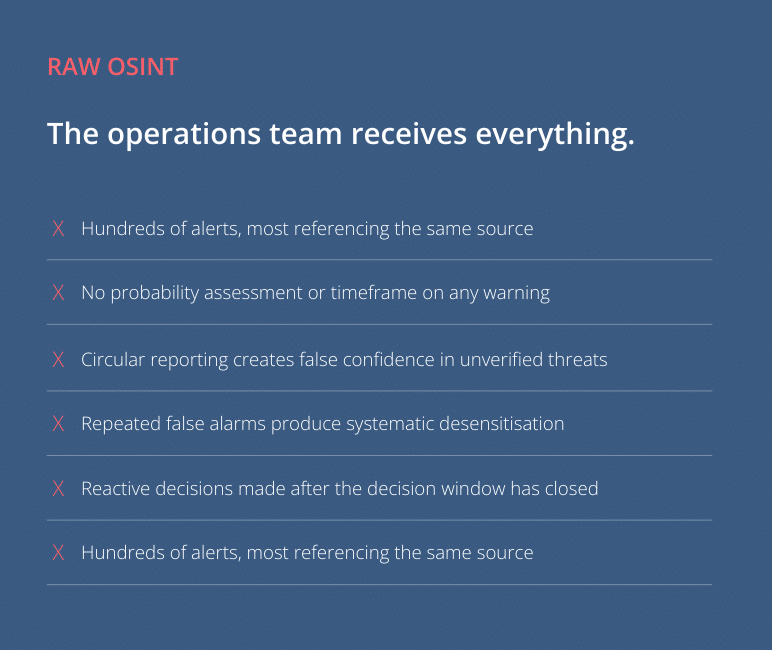
In an active conflict, open source channels never go quiet. They flood. The same story spreads across dozens of outlets, repackaged until it looks like independent corroboration.
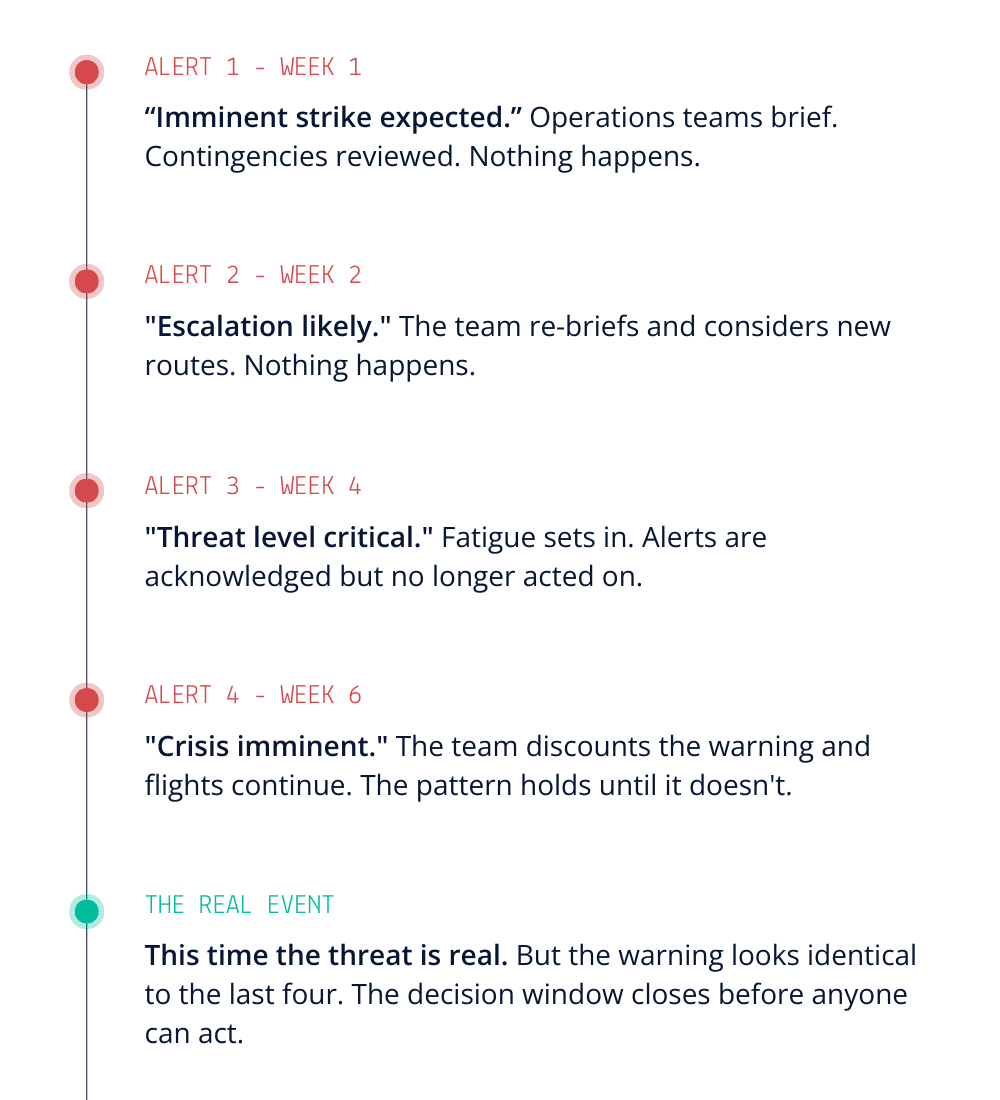
Repeated unactionable alerts train operations teams to treat all warnings as background noise, including genuine ones.
A single underlying source propagates across dozens of outlets. Ten alerts can represent one data point
By the time a threat is confirmed through open-source channels, the lead time needed to reroute has already passed.
No source verification Fabricated imagery and coordinated disinformation are designed to appear credible. Volume creates the illusion of consensus.
Between 14 and 17 July 2014, 61 operators from 32 countries routed their flights through this airspace. On the day of the crash, 160 flights flew over the area before the airspace was closed. The question that arose was: why were those aircraft flying over the eastern part of Ukraine?
Dutch Safety Board Final Report, October 2015
WHY OSINT ALONE IS NOT ENOUGH
Understanding the OSINT limitations that affect your decision-making is the first step toward managing conflict zone risk effectively.
THE OSPREY DIFFERENCE
The answer isn’t fewer warnings. It is better aviation risk intelligence that is verified, contextualised, and delivered before your decision window closes.
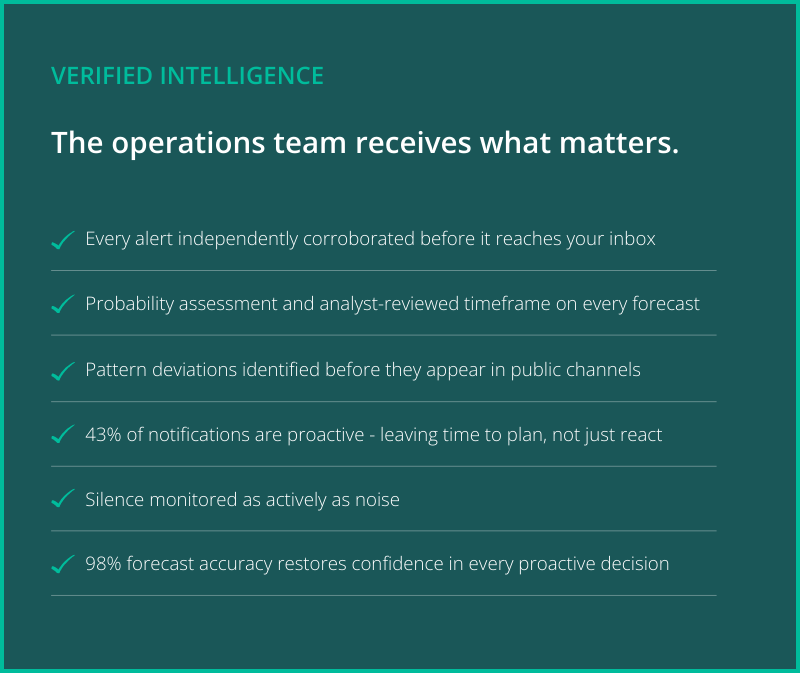
Every signal we find is assessed against four criteria before it ever reaches your desk.
We monitor 200,000 sources in 60 languages. A story appearing in 40 outlets from one origin counts as one data point, not 40.
Our machine learning identifies shifts that don't make the news. We track unusual military movements, AIS transponder changes, and even light intensity shifts in tense regions.
When a busy location suddenly goes dark, that silence is a signal. We monitor for the moments when the normal world stops communicating.
We don't just give you a "safe" or "unsafe" binary. We provide probability assessments and analyst-reviewed timeframes so you can plan a reroute instead of reacting to a cancellation.
sources monitored continuously
forecast accuracy rating
languages reviewed
THE OPERATIONAL DIFFERENCE
FILTER THROUGH THE NOISE
Osprey monitors the data you cannot see in a standard news feed. We track the subtle indicators that precede a crisis.